How to Choose the Best Caster Trolley for Your Needs?
Selecting the best caster trolley is essential for ensuring efficiency and safety in various work environments. According to a recent report by the Material Handling Industry of America, proper use of caster trolleys can reduce manual handling injuries by up to 30%. This emphasizes the importance of choosing the right equipment for your specific needs.
Expert insights further validate this critical choice. James Turner, a leading consultant in the caster trolley sector, stated, “The right caster trolley can significantly enhance productivity while minimizing operational risk.” His perspective underlines the need for thoughtful consideration when selecting these tools.
In an industry filled with options, it’s vital to understand your specific requirements. Factors such as load capacity, wheel type, and material affect performance. Each choice presents unique benefits and challenges. Sometimes, an inadequately matched trolley can result in inefficient workflows. Assessing your needs carefully may lead to better long-term results.

Understanding Your Specific Requirements for a Caster Trolley
Choosing the right caster trolley can enhance your workflow significantly. Start by understanding your specific needs. Consider the weight capacity required. Different tasks demand different strengths. A trolley for heavy equipment needs robust wheels and a solid frame.
The size of the trolley is equally important. Measure the space where you'll be using it. Too large a trolley can hinder movement, while too small may not suffice. Look at the type of surface you'll navigate. Will your trolley roll over smooth floors or rugged terrain?
**Tip:** Always check the wheel material. Rubber wheels offer better traction and absorb shock well.
Examine the functionality you need. Do you require a folding trolley for easy storage? Is a fixed design more suitable? Think about the frequency of use. Heavy daily use may require a more durable design. Frequent users might need to invest a bit more in quality for longevity.
**Tip:** Consider trying out a few options. Test their maneuverability and ease of use. Sometimes, price and looks can be deceiving. Reflect on what works best for you in real-time scenarios.
Choosing the Best Caster Trolley: Load Capacity Comparison
Comparing Weight Capacity Standards for Various Caster Trolleys
When selecting a caster trolley, weight capacity is a pivotal factor. Different types of caster trolleys offer varying standards in load-bearing capabilities. The American National Standards Institute (ANSI) provides guidelines on weight capacity classifications. Typically, light-duty trolleys can support up to 300 pounds, suitable for small tasks. Medium-duty options range from 300 to 1,200 pounds, often used in warehouses. Heavy-duty models can carry loads over 1,200 pounds, ideal for industrial settings.
Industry reports indicate that beyond the weight limits, the distribution of weight affects stability and functionality. An uneven weight distribution can pose risks, leading to accidents. For instance, a load placed too far forward or backward may overload one side of the trolley, compromising safety. Many users underestimate this aspect, highlighting the need for caution in practical applications.
It's essential to consider the operating environment as well. Trolleys used on smooth surfaces may perform differently than those on rough terrain. The material of the caster wheels also plays a significant role in weight capacity. Polyurethane wheels are known for their durability and load-bearing capabilities, while metal wheels can handle heavier loads. However, the choice of wheel should align with the surface type, requiring careful consideration of your specific needs.
Evaluating Wheel Types: Rubber, Polyurethane, and Their Applications
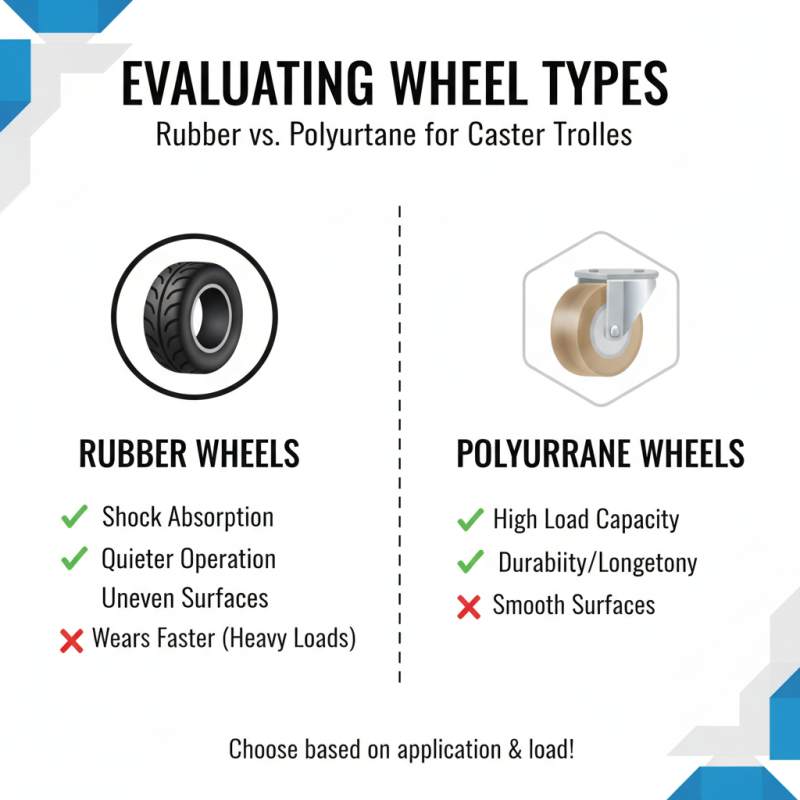
When choosing a caster trolley, the type of wheels is crucial. Rubber and polyurethane are popular materials, each with unique features. Rubber wheels offer excellent shock absorption and are quieter. They work well on uneven surfaces. However, they may wear out faster under heavy loads.
Polyurethane wheels provide durability and resilience. They are resistant to abrasions and chemicals. This makes them suitable for various applications, especially in industrial settings. Polyurethane wheels glide smoothly on multiple surfaces, reducing effort when moving heavy items. Keep in mind that they can be more expensive than rubber alternatives.
Here are some tips for selecting the right wheel type:
- Assess your environment. If the floors are smooth, polyurethane may be a better choice.
- Consider load capacity. Make sure the wheels can handle the expected weight.
- Think about noise levels. Rubber wheels will generally be quieter than other materials.
Evaluating your needs carefully can lead to smarter choices. Remember, the right wheels enhance the trolley's functionality and longevity.
Assessing Maneuverability and Stability in Caster Trolley Design
When selecting a caster trolley, maneuverability and stability are vital aspects. A study conducted by the Caster and Wheel Institute indicates that trolleys designed with larger wheels often perform better on uneven surfaces. This creates better maneuverability in tight spaces. However, larger wheels may sacrifice stability under heavy loads, which can lead to potential mishaps.
It's essential to assess the design details closely. Trolley height, wheel spacing, and weight distribution significantly impact stability. A well-distributed weight maintains balance, especially when carrying heavy items. Research shows that trolleys with a low center of gravity exhibit enhanced stability. This can prevent tipping, which is a common issue.
Tip: When testing a trolley, try maneuvering it fully loaded and empty. Notice how it handles both weights. Consider your specific needs. Will you primarily use it indoors or outdoors? Different surfaces may require different designs. If you find instability during tests, rethink your choice. Prioritize design features that enhance both mobility and stability for safer usage.
How to Choose the Best Caster Trolley for Your Needs? - Assessing Maneuverability and Stability in Caster Trolley Design
| Feature |
Description |
Maneuverability Rating (1-5) |
Stability Rating (1-5) |
| Wheel Type |
Polyurethane wheels for smooth surfaces, rubber wheels for rough terrain. |
4 |
5 |
| Load Capacity |
Maximum weight that can be safely carried. |
3 |
4 |
| Handle Design |
Ergonomic designs enhance control during movement. |
5 |
4 |
| Base Stability |
Wider base provides better stability for heavy loads. |
4 |
5 |
| Braking System |
Locking mechanism ensures safety during loading/unloading. |
3 |
5 |
Factors Influencing Price: Quality, Brand, and Material Choices
When selecting a caster trolley, price is influenced by various factors. Quality is paramount. Higher-quality trolleys often use better materials, leading to improved durability and performance. Consider how often you will use the trolley. For heavier loads, investing in a premium option may save you money in the long run.
Brand reputation also plays a key role in pricing. Established brands often command higher prices due to their track record. However, lesser-known brands may offer competitive alternatives. Researching customer reviews can provide insights into reliability. Don't overlook materials. Steel, aluminum, and plastic offer different benefits. Steel is strong but heavier, while aluminum is lighter but may not support as much weight.
Reflect on your specific needs before making a decision. Do you need a trolley for occasional use or for heavy daily loads? Think about your environment. An indoor trolley may require different features than one used outdoors. Balance your budget with the specifications that matter most to you. Investing thoughtfully can enhance your productivity and satisfaction.